

WHY WATER BUFFALO
It starts with the milk.
Animals that live well give better milk. Better milk makes better food.
HOW THEY LIVE
Exactly as they were meant to.
Water buffalo are native to the tropics. It's where the species comes from, and it's the one climate that asks nothing of them.
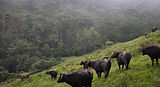
The herds in the Colombian Andes live there year-round. They graze open pasture on grass alone — no supplemental feed, no confinement, no seasons to work around, no winter to compensate for. What they eat is what grows around them, and it grows all year.
The families who raise them don't do much either. They move the herds, they watch them, and they keep the land in condition to keep feeding them. The milk is the animal's work.
When an animal lives completely as it should, the milk can't be made any better.
IN THE GLASS
You can see it before you taste it.
Pour water buffalo milk next to cow's milk and the difference is immediate. It's pure white, not yellow — water buffalo don't pass beta-carotene into their milk the way cows do. It's denser. Noticeably richer, with more butterfat and more protein. And because these animals eat grass and nothing else, the fat itself is different — grass-fed milk carries more omega-3s and more conjugated linoleic acid than grain-fed milk does. Diet shows up in the milk.

And it's naturally A2. Milk protein comes in two forms, and most cow's milk sold today contains both A1 and A2. Water buffalo produce only A2 — not a breeding program or a marketing decision, but the only protein the species has ever made. Eurofins has verified it in our milk. It's the A1 form that many people who struggle with dairy do better without.
Flavor is where it surprises people. All that fat could easily read as heavy, and it doesn't. It's clean and delicately sweet, with none of the barnyard note a richer milk usually brings. That's what makes yogurt that sets thick on its own, mozzarella that stays tender, and a dulce de leche people remember.
A DIFFERENT KIND OF THICK
Thick because of the milk, not the machinery.
Greek yogurt and skyr get their thickness by subtraction. Milk goes in, water and whey are strained out, and what's left behind is concentrated. It takes roughly four times the milk to make the same amount of finished yogurt — four times the herd, four times the footprint. The straining takes energy, and it leaves acid whey behind, which is difficult to dispose of responsibly.
Water buffalo milk arrives thick. There's nothing to strain out and nothing left over. It sets on its own with cultures and time — no gums, no gelatin, no milk powder, no stabilizers, no colorants.
Our plain yogurt is milk and cultures and nothing else. Five grams of sugar, all of it the milk's own, none of it added. An excellent source of calcium — twenty percent of a day's worth, from the milk alone. The protein is whatever water buffalo milk contains, because nothing was taken out to raise the number. The honey and fruit flavors are exactly what they say: real honey, real fruit, and the sugar those bring with them.